Tuesday, 5 July 2016

Burgtiefe - Svendborg, Denmark (5 July 2016)

We returned to Fehmarn Island on Monday 27 June. Our journey from the UK started with concern as our first train (First Great Western) was running 10 minutes late thus risking our connection at Salisbury. As it happened we made it only to join a train packed with muddy Glastonbury campers heading home, most of them asleep! The journey involved taxi from home to Warminster; train to Salisbury then train to Woking; minicab to Heathrow T5; Flight to Hamburg; S Bahn train to Hamburg hbf (central station); ICE train to Puttgarden; local train to Berg; taxi to Bergtriefe Marina. Left home 0840, arrived 2000LT (1900 BST), so just over 10 hours.
Tuesday was spent on shopping for stores and readying the boat together with a walk around the nearby beach.
The weather forecast for Wednesday was for a fresh breeze from the SW but some likelihood of rain overnight and into the morning. We resolved to make a prompt 0800 start but at that time the sky was universally black or dark grey and rain was coming down in stair rods with consequent poor visibility, so we decided to postpone for a while. It took until 0930 for the rain to ease but we slipped the mooring to head into what was then a strong S wind. Initially we had to motor about 3nm south but we could then turn to starboard to pick up the buoys that mark the channel that takes you through shallow water and under the road and rail bridge that links Fehmarn island to the mainland. By then the wind had turned more W but we were motor sailing. Once we had passed the shallows off the SE side of Fehmarn Island and were turning on to a NW course we unrolled the genoa and turned off the engine to begin a pleasant few hours sailing at 5-6kn towards the Danish islands. By mid afternoon we had sunshine and could see the S coast of Langeland and we began heading in a more N direction standing off but in parallel to the coast. At this stage the wind picked up becoming a NW F6 with gusts to 30kn making the sea lively, so it was pleasing that about 7 hours and 35nm after slipping our mooring we were mooring in the harbour at Bagenkop, our first port of call in Denmark.

Bagenkop harbour, Whileaway in the foreground.
Bagenkop is a traditional fishing village with ship support facilities. As fishing has reduced in scale leisure activities, mainly camping and holiday homes, have increased. We were immediately impressed by the smartly uniformed Harbour Master (complete with peaked cap) who came round in the early evening to collect the dues!
The following day, again one with grey clouds and a strong wind in the morning, we cycled round the village, inspecting the church with its model ships hanging from the ceiling and then buying some locally caught fish from the fishmonger. After that we headed into the open country towards the southern tip of the island. This part of Langeland has a unique landscape with many small round shaped hills created during the last ice age. There are some large tracts of open country and for many years wild Exmoor ponies have been allowed to roam as they do a great job of maintaining the natural landscape and are very hardy able to stand the cold and snowy winters. We were lucky enough to come across a big herd, including young foals, and they were confident enough not to be spooked as a few other visitors and ourselves came within about 4m of them.

Exmoor ponies on Langeland
The outlook for Friday was not good as the wind was forecast to be at the top end of F5 and close to our heading. But we had less than 10nm to go so we set off around 0930 for Marstal on the nearby island of Aero. It was not a pleasant trip as not only was the wind constantly towards the top of F6, but also a big sea had been set up and it was right on our beam causing the boat to roll strongly from time to time. However in just under 2 hours we were following the narrow channel towards the harbour and then tieing up within another of those perishing boxes! Aero is in the South Funen Archipelago and is just served by ferries as there is no bridge. It is about 30km long and 9km at its widest point and has a population of over 6,000. It is said to be one of the prettiest islands in Denmark. There are three towns and Marstal is the most southerly.Marstal is the largest town and has a long maritime history which is evident everywhere. It still has a small commercial dockyard and floating dry dock for repairs as well as a nautical school where navigators are taught. The town itself has narrow alleys and passageways and quite a collection of shops.

Impressive merchants buildings and cobbled streets
That evening we ate out at a small simple restaurant next to the marina. It was busy and after a while we were asked (as others had been) whether we would share our four place table with another couple. This turned out to be Jurgen and Monika, a sailing couple from North Germany, who spoke excellent English so we had a very interesting discussion with them about the disastrous referendum result and why this problem had arisen! Not surprisingly I think that they are bewildered by the logic of the decision but also mystified by the assumption that the EU will want to create a generous trading arrangement for the UK!
One excellent service on Aero is an hourly free bus service that links the three towns. So on Saturday morning we "sailed" the bus to the northern town of Soby. There some sort of local event was taking place, involving men jousting with lightweight poles whilst balancing on a couple of telegraph poles above the harbour. Needless to say there were plenty of splashes!

Traditional challenge in Soby!
 The town is small but attractive. We then took the bus back, stopping off for a few hours at Aeroskobing which is half way up the northern coast. Aeroskobing is described as probably the most well preserved Danish town of the eighteenth century although it dates back to the middle ages.

Looking towards the harbour in Aeroskobing
Aeroskobing has cobbled streets, beautiful flowers (plenty of hollyhocks) and many small well preserved houses with some interesting details and curiosities! It is recognised as a site of national significance but not with standing that it seems to be lively and interesting.

Old house and newer three wheeler run about!
Returning to Marstal we met Jurgen and Monika again, looked over their lovely seventy year old restored yacht and chewed over politics and sailing over a beer!
Through Saturday/Sunday night it seemed to rain continuously but amazingly about 0900 it stopped and we prepared to slip our mooring. I checked the weather forecasts from two sources. They gave similar but not identical results with SW wind speeds of around 8-9 metres per second (the common unit in the Baltic). That equated to Beaufort Force 5, so an assumption that we might get gusts to F6. Our passage was going to be about 25nm W to Faaborg on the island of Fyn. For about the first hour and a half this involved following buoyed channels that kept us in water with a minimum depth of 2.5-3m (we need 1.4m absolute minimum). After that 90 minutes we then had about two and a half hours in deep water (up to around 30m) before approaching Fyn between the islands of Avernako and Lyo and then Knoldon and Bjorno. This again involved careful navigation as we skirted areas of shallow water and isolated rocks.
Our departure started well enough with a pleasant F4 W breeze but as our journey progressed this increased to F5, then F6 (11-14 m/s) with gusts to F7 (15m/s, 33kn). We could see big storm clouds around us and the wind also became more W so we were motor sailing just off the wind at times. I did head further W than planned trying to seek some shelter from the NW part of the island of Aero and when the wind was over 30kn and still climbing I did discuss with Andrea seeking refuge in the harbour at Soby that we had visited the day before. But we decided to carry on and the wind began to abate and towards the end of the passage we did get shelter from the islands as we passed them. But this was the third consecutive passage where we have had winds of F4-5 forecast and F5-6-7 delivered so we will be even more cautious about the forecasts in the coming weeks!
We found plenty of space in the town harbour at Faaborg and picked a box next to a Danish couple. As the afternoon wore on the sun came out and the wind dropped. The next day gradually became warm and sunny too so we had plenty of opportunity to explore an interesting small town. It retains its maritime heritage with a few fishing boats, ferries to smaller islands, ship repair and servicing facilities and visiting historic sailing ships carrying small numbers of cruising enthusiasts (about 20 people is typical). Just along from the harbour front is  a new harbour bath; this has a new wooden pier and harbour staircase enabling people to easily take a swim in the Baltic sea.

The pool at Faaborg
The town itself has many cobbled streets and attractive medieval and later merchants houses with an attractive central square and one town gate from the middle ages. We particularly enjoyed climbing the recently restored bell tower of the Holy Spirit Church, the only part remaining from the original 1450 building.

From the bell tower
In the evening we ate at the cafe on the harbour side which has its own fish smokery (we also ate at a similar establishment in Aeroskorbing - who says that you can have too much of a good thing?). The fish of your choice is served with a traditional Danish potato salad. We also had some prawns (apparently called shrimps in Danish) smoked with garlic and some without. 
One thing that we have noticed is that food and other costs in Denmark are noticeably more than at home and in Germany and the Netherlands. With the collapse of the £ caused by the Brexit vote costs may be 20-30% higher, probably a more reasonable 10-20% higher pre-Brexit vote. One factor is that Danes are paid noticeably higher wages, especially at the lower end of the scale and this rightly feeds through to costs. They also pay higher taxes but, as we have been reading in a book "A Year of Living Danishly" they get higher quality health and social support plus a much better standard of living in return. It is not surprising that polls show Danes at or near the top of polls for the happiest and most contented peoples in the world.
Overnight and Monday morning bought the forecast lighter winds but a leaden sky. So at 0900 we slipped the mooring to head 16nm west to Svendborg, also on Fyn island. As we left the harbour a British yacht arrived - just the second that we had seen in our five days in this part of Denmark. An uneventful passage passing between islands and under a 33m high road bridge led us to the very busy commercial harbour in the centre of the town. It soon began to rain heavily and with a forecast of a gale overnight and into the next day we committed to staying two nights. Between the spells of heavy rain we walked around the large shopping centre, a mixture of old and new, more workmanlike than traditional.
Old house - ill fitting windows and doors!
For tomorrow we have established that we can take the train to Odense, one of the largest cities in Denmark and the home of Hans Christian Andersen and plenty more besides.

Thursday, 9 June 2016

Norderney - Burgtiefe (8 June 2016)

On Monday 30 May we took the opportunity to explore Norderney, our first German port of call. I think that Norderney may be the largest of the East Frisian Islands but even then it is only around 8miles long and a couple of miles wide. The harbour and the ferry port are less than a mile from the smart town, Norderney being Germany's oldest spa and a nineteenth century royal holiday centre. It has some fine buildings facing the sea and a central park like square where café culture is clearly in evidence. The town was busy although a significant proportion of the visitors were noticeably older than us! In common with other East Frisian islands a significant proportion of the island (in Norderney's case about two-thirds) is a nature reserve. We spent the sunny afternoon cycling along the very quiet cycle ways and roads through the nature reserve and viewing the long sandy beaches.

Town centre street, Norderney
We had been thinking about which other islands to visit, there are four east of Norderney. The harbours are all very shallow and in some yachts sink into mud at low water. We were also conscious that the wattfahrwassern, the areas between the islands and the mainland, are all more shallow than south of Juist where we had quite a challenge en-route to Norderney. Having looked at the charts it was clear that we would have to go north of the islands, in the North Sea. The wind remained stubbornly NE so this was going to mean taking the tide but motoring into the wind. In the end, having evaluated the challenges of each of the entrances, I concluded that we should go to Wangerooge, the nearest island to our next call, Cuxhaven. In addition Wangerooge is a small island with a few novelty factors which attracted us, including no cars and lorries! The distance was about 30nm so a departure from Norderney about an hour before low water would enable us to take the tide from the harbour through the seegat (the channel between the islands) and then pick up the east going flood tide. This would also ensure that we arrived off Wangerooge before high water, an important point as there is a very shallow sand bar about three miles off the island and in addition the final approach to the harbour itself requires careful navigation as it too is shallow. We left Norderney just after midday and were soon having to motor directly into the NE wind of F4/5. However the waves were mainly slight after some initial buffeting so we made good time and were off Wangerooge approaching the bar about 2 hours before HW. Even so the depth over the bar was a minimum of 1.2m under the keel. This was the shallowest part of the entry, as we swept through the narrow seegat the depth touched 30m, before dropping sharply again so that in the final approach to the harbour we were down to 0.7m at one stage before increasing again to 2.4m in the very small harbour itself. Apart from about two dozen residents boats on finger pontoons there were just four visitors boats on a long pontoon. By the time we were nearing the pontoon there was a cheerful harbour master waiting for our lines and who introduced himself as “Tom” and welcomed us to Wangerooge! He pointed to his “office” which was in the sailing club bar, on the other side of the harbour and we said that we would come over in a short while. As we walked around the harbour to the Clubhouse (on stilts as were all the few other buildings we noticed), another interesting feature of the island began to appear round the coast – the train! The town is some 3miles from the only harbour but it is connected by a free train. The train brings people (mainly day visitors or longer holidaymakers) to and from the ferry which can only berth around an hour each side of high water. A second ferry brings freight and that too is loaded on to wagons to be taken back to town. As Andrea noted, the train had more coaches than are usually provided by South West Trains serving our local station at Tisbury!
Train heading to the harbour and ferry
Leaning on the Club House balcony we had an excellent view of the activity in this small harbour as the passenger ferry approached. Having paid Tom and got all the information that we needed we then requested a couple of beers which Tom duly served up. Sitting in the small bar we also had a chat with a couple of other visiting sailors and a guy (Fritz) who said that he was the local dentist and who had a motor boat. In conversation he talked about the hostility some people still feel towards Germans because of WW2. He said that he had experienced it sometimes (he mentioned in the Netherlands) but he just ignored it. He did recognise that for older generations who may have lost loved ones this might be an issue.
The next morning we were on our bikes along the shared footpath/cycleway to the town. The resident population of Wanerooge is around 1500 but in the peak holiday period this may be swollen by 5000 visitors. It is an interesting town with shops supplying essentials, a range of restaurants, houses dating back to the late nineteenth century and of course the main train station! Again there are very sandy beaches with interesting covered seats, a traditional promenade, an extensive nature conservation area and a very small airport. The commercial transport around the town and island consists of a variety of small electric vans or trucks, a reminder of milk floats! 
Transport arrangements in Wangerooge
 Near the centre of the town is the old lighthouse. We climbed to the top to see the views and also looked at their historical exhibition. This included a piece on the allied bombing of the island in 1945 when around 150 civilians and military personnel lost their lives. During WW2 the airfield was used by the Luftwaffe and this was obviously the target of the Lancaster bombers but it certainly appears that quite a few non-military buildings were destroyed. 

A view from the old lighthouse
  That evening I had a discussion with Tom in the Office/Bar about when I needed to leave the next morning to ensure that I safely crossed the sand bar. Tom's advice was to leave no later than HW-2.5hrs but perhaps no later than 2hours after HW to be on the safe side. My immediate doubts were that would be too late, given that I wouldn't be at the bar (the sea one!) until at least 30 minutes after leaving the harbour and the depth under the keel at 2 hours before HW on the inward passage was only 1.2m at minimum. Having reflected on it over night and woken to an overcast day with a F4 NE wind forecast I concluded that we wouldn't wait too long as after HW we would have to cross the bar with wind against tide which would create choppy conditions. On the other hand we only had c25nm to the beginning of the River Elbe and the advice on this was also clear that you shouldn't pass the fairway buoy until the tide is on the turn to give you the flood. On this day that suggested around 1720LT. So the earlier we crossed the bar the slower that we would have to go to wait for the tide to turn at the Elbe. Not a straightforward position! In the event by 1040 I had itchy feet so 40 minutes after HW we slipped our mooring. The first half hour or so was uneventful although the wind was stronger than forecast. However as we approached the bar all we could see were crashing waves and a sea of white water. We carefully stuck to the channel plunging up and down into 1+m waves with the depth indicator fluctuating wildly and for seemingly endless minutes reading “0” with the alarm going off. Eventually we crawled past the final port buoy and the depth beneath the keel slowly started reading positive numbers. Not a pleasant experience and one we don't want to repeat. I am very glad that we hadn't left our departure any later! We now turned into the wind and headed further out to sea. First we had to cross the busy shipping lanes of the R Jade (getting drenched in the first of two downpours in the process) then we began skirting the sands around the Elbe estuary. As it happened, 6 hours after our departure we were near the fairway buoy (around 1645), so we resigned ourselves to fighting the tide for a while. It lasted longer than expected and didn't tail off until around 1830 when it quickly began to help us. At 2045 we were tied up at the very small Fahrhafen Sailing Club harbour on the edge of Cuxhaven. We choose this in preference to the large commercial marina as it had been recommended by a Cruising Association member as very friendly and informal. When we arrived there was not a soul there but vacant berths had a green sign so we picked one. We eventually discovered some information about the arrangements plus an envelope to put our fee into near the gate at the end of the pontoon. Andrea happened to be there when a member arrived to put some items on his boat. He kindly showed her where the key to the Clubhouse was located and pointed at what looked like a house about 50m away and said that we could let ourselves in to use the shower and facilities! An amazing arrangement, so trusting, and the shower in the Clubhouse was like being in someone’s own home! Even the bar was unlocked but we respected the arrangements and, as requested, left the place clean and tidy.
We decided to leave exploring Cuxhaven for another time and at 0900 on a sunny Friday morning we took the tide to head 17nm to Brunsbuttel where the lock that gives access to the Kiel Canal is located. Having the tide with us and even after a brief wait, by noon we were in the lock and soon afterwards in very warm sunshine we began our motor down the canal. Soon some industrial wharves gave way to forested edges and reeded banks. The canal (officially the Nord-Ostsee-Kanal) was opened in 1895 and was primarily built to enable the German Naval Fleet to get from the Baltic to the North Sea without having to run the risk of passing around Jutland. It is reasonably wide with plenty of room (40m clearance) under the elegant bridges. So now it carries significant commercial traffic and is heavily regulated. 
Approaching traffic on the Kiel Canal
You cannot anchor, nor tie up except in designated moorings, so our objective was to get a little over halfway, to Rendsburg. Just after 1800 we turned into the Obereiderenge and to the far SW corner to RVR Rendsburg, an attractive yacht haven. This meant that in two days from Wangerooge we had completed 99nm so we were having Saturday at rest.
Of course not quite at rest as we decided to explore the town and do some shopping and washing too. It was just 10 minutes walk into a medieval city with fine 16th century and later buildings. Being Saturday there was a market in the town square from which we obtained fresh asparagus, strawberries, local cheeses (recommended by the chatty cheese monger but very strong tasting (he said medium!) and some local cake. The rest of our requirements were met by Aldi and another supermarket. When we were back in town for another walk round later in the afternoon we were amazed to discover that nearly all the shops had closed at 1400 so it was quite quiet!

Theatre at Rendsburg
On the previous day our friends Pieter and Griet in Watervogel had made the long passage from Norderney to Cuxhaven. Pieter had messaged me on Saturday morning to say that they would try to make Rendsburg and we received regular updates so soon after 1830 we were delighted to take their lines as they arrived. We had a very enjoyable sunny evening together.
On Sunday morning they left about 30 minutes before us heading for Holtenau (the lock that lets you into the Baltic Sea) and then on to Laboe for the night. Our destination was a little short of that at the British Kiel Yacht Club. The 20nm passage down to Holtenau was uneventful. At Holtenau there are two locks for leisure craft and two for commercial ships. Here you must also pay a fee of 20 Euro for use of the canal. But since 2014 the leisure craft locks have been out of action with major works being undertaken. So leisure craft have to fit in with the big ships in the commercial lock. It has also led to fees for leisure craft being suspended. It is thought that this is because to get to the kiosk to pay the fee requires climbing up and down a slippery vertical ladder on the wall of the lock and the authorities are fearful of the risk of accidents. Whilst this is a saving we did have to wait over half an hour to enter the lock as two ships were on their way to Holtenau and needed to be moored up inside the lock before we joined them.
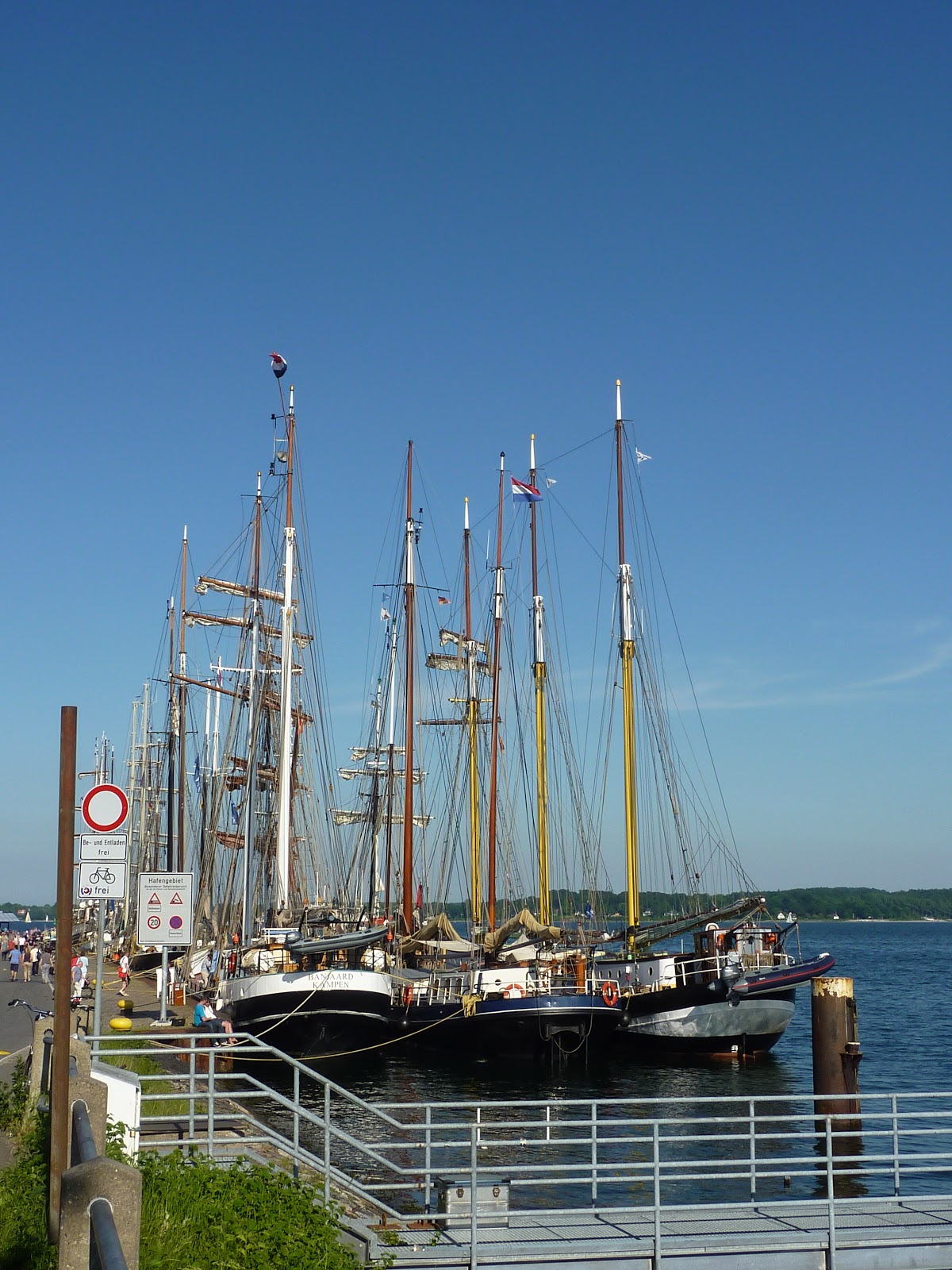
It was then just a short distance to the British Kiel Yacht Club, originally established at the end of WW2 and ever since used as a base for UK military personnel to enjoy adventure training. With the wind down of the British presence in Germany it is due to close permanently later in 2016 so we had been encouraged to make what would be a once only visit. As it happened we did not cover ourselves in glory as a brisk wind on the beam coupled with Whileaway's reluctance to go astern in a straight line meant that we provided entertainment on how not to secure up in a box mooring. We did eventually get in and it turned out to be a very quiet afternoon and evening as the place was practically deserted. We did though walk back to near the locks as we had noticed on our transit that there were over a dozen tall ships at some sort of festival there so went along to view them. This entailed a walk through the old British base, long ago handed back, with married quarters now occupied by Syrian, Iraqi and other refugees given a safe haven by Germany.

Tall ships visiting Holtenau
 On Monday it was 0930 by the time that we were away, heading first northerly out of the Kieler Forde and then turning East. The weather forecast was for a NW F4 so that offered the prospect of some sailing. Indeed by midday we were sailing but close hauled and regularly tacking as the wind was NE, By mid afternoon the wind had come round a little to ENE and increased so now it was always at least F5 and increasingly F6 (22-27kn). Making ground was becoming more difficult so we restarted the engine and were soon ploughing in to strong winds and an increasingly steep sea, slowing us down somewhat. By the time that we were on the long approach to Heiligenhafen the wind was gusting to 30kn (F7). If coming from the W, to gain entry to the harbour you have to pass a 2km long sand spit then turn and return inside it along a narrow channel which we easily picked up. Once inside the large marina it was clear that getting into a box mooring would be tricky in this wind so we found an alongside pontoon used for temporary moorings and the next morning the harbour master said that we could stay there for the day. Heiligenhafen is a large yacht, fishing and commercial harbour so it has a busy and interesting town and harbour side. There is an interesting old church where as is the tradition in ports there were model ships hanging from the ceiling.
 
Model ship in the old church

A short distance away is a beach resort with large hotels. We looked round the pretty market square and after lunch cycled along the sand spit seeing the many birds on the protected area and accidentally disturbing a gull that had built its nest on the edge of a footpath to a viewing platform which was just open for a few hours each day. 
 
Part of the sandspit

 We also cycled to the beach resort but were unimpressed with that! A fish supper seemed appropriate given the fishing activity! We later discovered that Watervogel had arrived and so had a quick catch up; they are heading to the E coast of Sweden for a month or two so it will be our last meeting with them.
On the following morning we made the short journey to Burgetiefe on Fehmarn Island where we are leaving the boat for a couple of weeks to return to the UK. For the first time since we left Sneek over two weeks ago we had a wind that didnt have E in it! It was NW so we had a pleasant sail running before the wind under the rail and road bridge and into the harbour. It was though another day where the wind was strong gusting to F6 so getting into the box was a challenge but we eventually made it with the help of a guy on the pontoon who took our bow lines. 

Burgstaaken harbour
 On our last day we visited the yard in nearby Burgstaaken where we will be leaving Whileaway in the winter and which is about 2km away. This is another old fishing port with a busy town centre. Fishing is still an activity as is tourism, including a historic U boat.

Main street Burgstaaken
On Friday it is a couple of trains to Hamburg then a flight to Heathrow,and coach, trains and taxi home. On this leg from Sneek we had travelled 360 Nm in the 15 days and have got ourselves into the Baltic which will be our base for the rest of this year and perhaps next.


Sunday, 29 May 2016

Sneek - Norderney, Germany (29 May 2016)

We returned to Sneek very efficiently on Tuesday 24 May having flown from Southampton to Amsterdam and then onwards by the very effective Dutch railways.
We had taken the precaution of checking, through a Dutch Cruising Association colleague, that the first bridge at Leeuwarden was now back in operation. Thankfully it was and we negotiated the many bridges, including another one undergoing works. This was a railway bridge and the helpful Bridge Master said that he would have to contact the station to see when he could open. It also transpired that the construction work had to stop as the bridge swung so we also had the bridge workers waving us through! There are quite a few bridges in Leeuwarden but we passed through that very attractive city in about a couple of hours.


Leeuwarden's leaning tower
After leaving Leeuwarden the canal became very rural with reeds at each side and little traffic. But there were still bridges. Usually bridge or lock openings are free. But in some Frisian towns it is customary to pay Brug Geld, a fee for the bridge. Often this involves putting the appropriate money into a wooden clog which is dangled from the Bridge Master's window on a long pole as you pass; so a speedy deposit is required!

Brug Geld payable so Andrea stands ready to grab the clog as we slowly pass
Having made reasonable progress (in canal travel terms) we were contemplating mooring for the night in Dokkum, an attractive Frisian town. However we opted instead to moor at one of the occasional pontoons provided on the canal side in the middle of open country. These pontoons are designed to allow up to three medium size (10m) boats to tie up. The maximum stay is 24 hours and there are no facilities; but also no charge. The one we choose was only about 4km from Dokkum so out came our folding bicycles and we headed along the nearby cycle path to town.
The casual mooring in the middle of open country
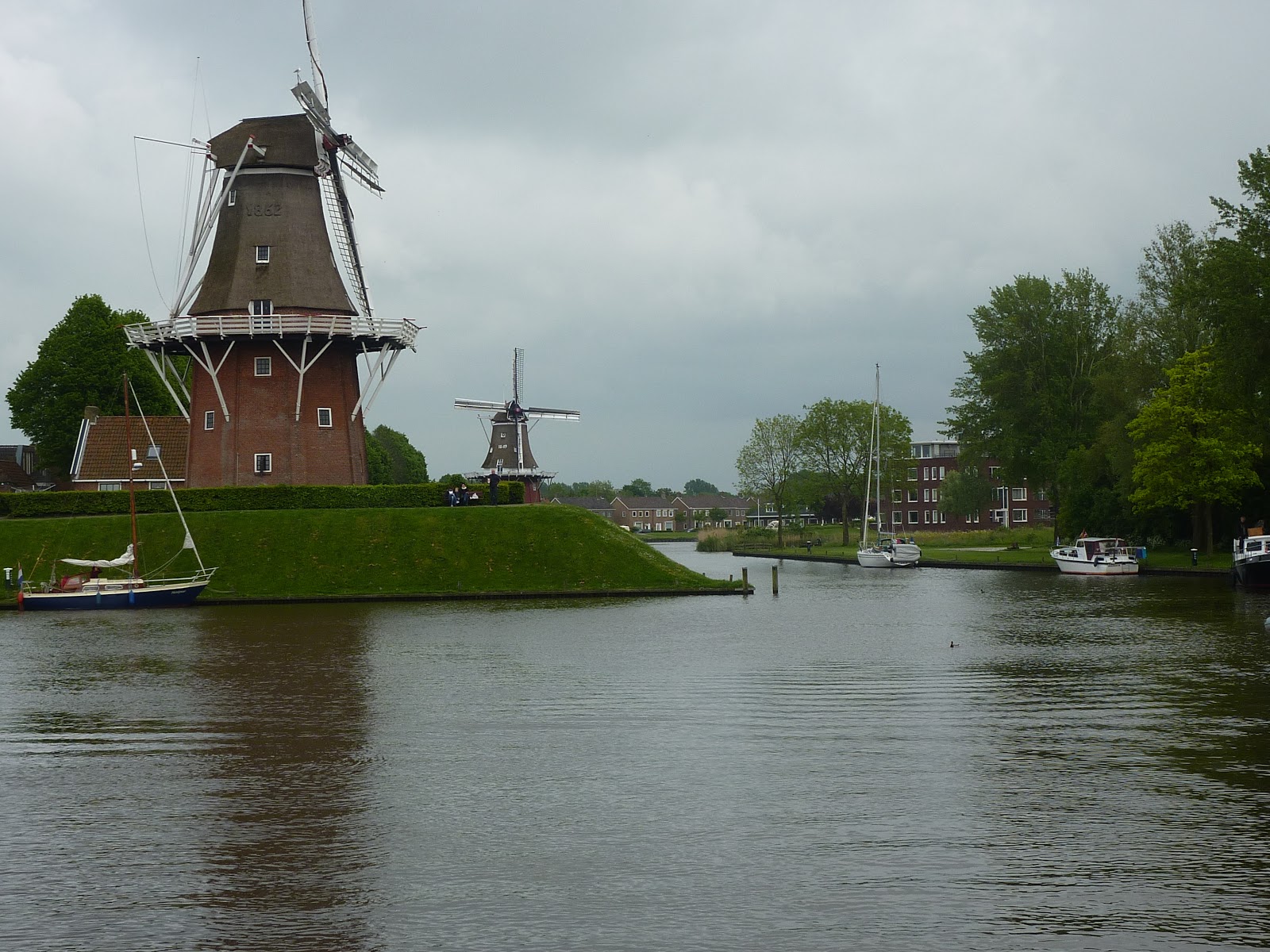
Dokkum is built on a mound so most unusually for the Netherlands has sloping streets! On the five points of the mound there were originally defensive forts but in the nineteenth century three of these were replaced by windmills which still stand today. It also has attractive historic buildings and a network of canals, the main ones being wide and attractively landscaped. Although now inland it was once a flourishing port.
On board Whileaway it was a very quiet evening. Until we cast off the following morning no one passed on the canal or the footpath and being in the middle of fields we were surrounded by bird life. We particularly enjoyed the black tailed godwits with their noisy call and rapid flight. At least one pair had a young chick which they seemed to be teaching to fly. Amazingly they weren't scared of us and walked within feet of Andrea as she stood on the path. A lovely tranquil evening and an enjoyable way to start the next day. We planned a shorter travelling day on Thursday and there were many fewer bridges. We began by passing through Dokkum.
 
Canals surround the mound on which the old town of Dokkum stands

After a few bridges in small towns we then passed through a lock and into the Vaarwater naar Oostmahorn, a wide estuary cut off from the Waddenzee by a large dam. We continued heading east along the scenic river or canal with fields of highland cattle at the waters edge. They are grazed here as the ground is rough and (presumably) wet and they can cope with such conditions and stay out throughout the year.

Highland cattle, some taking a dip!

By lunch time we were at Zoutkamp, tied up alongside in the Binnehaven (the old harbour).
Zoutkamp was established as a fortress by the Spaniards in the sixteenth century and was then taken over by the French. It has a strong industrial and fishing past and boasts a fishing museum.
After finding the Harbour Master (Owner/Manager of the bar/restaurant at the head of the harbour) we explored the small town and had a fish plate for dinner at a local restaurant where the owner was interested to know where we had been and why we were in Zoutkamp. 
 
In the Binnehaven at Zoutkamp
Our plan was to move on about 20nm to Gronigen the next day. However we decided that if we made an early start we might be able to make Delfzijl. We had of course already spent time in Gronigen delivering and then reclaiming our car after the problem with the bridge at Leuwarden hampered progress somewhat. It is an attractive city but having spent many hours there we decided that we would see if we could make Delfzijl. To do so would mean us getting through more bridges than we had ever achieved in a day, many of them in Gronigen and its environs. Just after 0745 we slipped our mooring and moved out of the Binnehaven to join two other boats that had just come through the Zoutkamp bridge. 
 
Typical village or small town lifting bridge

At the first bridge we were to be joined by another boat and that and one of those from under the bridge stayed with us throughout the day. We passed through a succession of bridges and by soon after 1100 we were on the far outskirts of Gronigen and into a truly horrible lock. Unusually there was a significant change in the water level and as it rushed in the boats were buffeted. We lost a steel plate that covers the rubbing strake with a plop as we were bounced against the lock wall. Grin and bear it! Onwards to begin tackling one bridge after another. One held us up a little longer than others but it was a railway bridge!

Through the centre of Gronigen
We got to about bridge five or six where we had to wait. Then the Bridge Master appeared on his bike. In the Netherlands towns Bridge Masters sometimes cover two or perhaps three bridges, cycling between them to open them. So sometimes you are let through one but then have to wait for the Bridge Master to cycle by you to open the next bridge. The Bridge Master duly opened the bridge and let two oncoming craft through. He then promptly shut the bridge and peddled off – it was just after noon and all the bridges shut for lunch from 1200 to 1300!

We can see the Bridge Master hurriedly cycling from one bridge to the next!
Soon after 1300 we were permitted to continue and by about 1430 we were leaving the last of the Gronigen bridges behind and heading the 15m to Delfzijl.
We enjoyed travelling right through the centre of busy Gronigen especially the squeaks of the University students and others as Bridge Masters tried to close the barriers on the many cyclists and pedestrians seeking to cross to allow the bridge to be lifted.
We finally got to Delfzjil (now with six boats in company) at around 1700. We had all opted to moor in the sea side of the harbour so had to go through the lock and we were now mixing with big sea going ships and barges. Fortunately Pieter and Reita on Watervogel who had been with us since soon after Zoutkamp were in contact with the Lock Keeper and we had instructions as to where to wait.
We were moored in Delfzijl at 1750 after 10 hours motoring, having completed just 34nm but set a record for us of having had 31 bridges lifted as well as the 2 locks.
That evening I exchanged passage plans with Pieter as he too was heading for Norderney through the wattfahrwassern, the drying channels between the mainland and the islands. Originally all this area was land but at some time the sea flooded the area creating the low lying islands.
On a sunny Saturday morning with a light NNE wind we left Delfzjil in company with Watervogel heading for the German island of Norderney. As at times we are using shallow (some drying) channels between the islands and the mainland with very careful pilotage is required so that you do not run aground. This route also requires anchoring for 2 hours in deeper water south west of another island, Borkrum, to wait for the tide to turn as we have to get over a drying patch. When  Watervogel anchored and was going astern to dig the anchor in the gearbox cable broke and thus the engine couldn't be got out of reverse gear! So after discussion of all the options (and having switched off the engine) we offered to tow Watervogel slowly back the 15nm to Delfzjil. Repairs were carried out after the weekend. 

Towing Watervogel back to Delfzijl
We set off again the following morning in less favourable conditions. We again anchored at bouy 39 until 1345. The wind was then F5, around 20kn, much more than the forecast F4. A German boat Ciao Mare came past just as were raising the anchor. So we followed her. We had just 0.1m (4 inches) minimum clearance on the first drying patch. Then a little way past we were in the middle of a deeper channel just behind and parallel to Ciao Mare and we both hit a sandbank not marked on the charts. We were both aground for 20 to 25 minutes in F5/F6. In the choppy conditions we bounced a bit so it was not a nice experience. But we both struggled off and found the deeper water again. At this point we were also fighting the tide and the wind on the nose which slowed us down so we were a little late at the next drying patch where we have to follow a narrow channel marked only by withies (tree sapplings) on one side. The minimum there was 0.4m luxury of 15 inches under the keel. Half way along the 2nm of withies we had to avoid a fishing boat then a car ferry coming the other way! We were very surprised that they were also using this very narrow channel as we passed close by. Eventually we arrived in Norderney at 1830 by which time the wind had dropped to F4. Once we had passed the withies and were on the last 5nm stretch to Norderney the German skipper of Ciao Mare called on the VHF to  invite us to his boat for a drink later to help steady all our nerves! He later told us that he had travelled this passage three or four times and this was the first time he had run aground. Exchanging notes and looking at the paper and electronic charts it is clear that we were in a buoyed channel when we ran aground!
A restful day in Norderney was now planned!

Wednesday, 4 May 2016

Amsterdam - Sneek (3 May 2016)

Off again on a new season of cruising!

On 19 April we took the overnight ferry from Harwich to the Hook of Holland and by just before 10 am were at Orange Nautical services where Whileaway had been stored for the winter. On Wednesday we completed the last few winter jobs; on Thursday she was craned back into the water; and on Friday morning the mast was stepped. These few words summarise three hectic days work as we put various pieces of Whileaway back together again! There were a few last minute snags, but fortunately all were overcome. Helpfully we enjoyed sunny and dry, if a little chilly, weather. But that was to change.
Whileaway dangling mid air!
On Saturday 23 April at 0830 we cast off with the aim of a long passage to Lemmer on the east coast of the Ijsselmeer. With a fair wind we would be there by around 1800. There was a brisk breeze as we motored through central Amsterdam but we made good time to the Orangesluizen, the lock built in 1882 at the eastern end of the canal which admits you to the Markermeer. After just a brief wait for the lock to open and then what seemed a negligible fall in water level we were out and heading a very short distance to the Schellingwouderbrug. We have been under this busy lifting road bridge a few times and know that, apart from in rush hours, it opens every 20 minutes.At 1030 then, only 10 minutes to wait. A couple of other boats were waiting too and when at around 1045 a Dutch boat turned around and passed us he shouted across that it wasn't opening until 1500! We returned to the waiting pontoon at the lock and, in company with a crew on a German boat, headed towards the lock keepers look out. There we were told that the bridge had a mechanical defect that had caused it to break down. Temporary repairs had been made but until a permanent replacement part arrived they were limiting lifts to three times a day! That was the end of our plans to make Lemmer that day! We did though have a wander through the immediate vicinity and take lunch at a very impressive Garden Centre!
Schellingwouderbrug firmly closed!
By 1500 a flotilla had gathered and the bridge duly opened to let the many waiting boats flow both ways. By now the weather had, of course, deteriorated and so we ended up motoring into an increasingly gusty NW wind (soon on the nose) towards our revised destination of Enkhuizen on the west coast of the Ijsselmeer. Initially the wind was around 20kn and the sea just choppy, but by the time we were passing Marken (about half way to our destination) we were getting prolonged gusts of 26-29kn (F6/7) and significant waves which we were ploughing our way through. All this slowed us considerably and at a couple of stages I was weighing up the merits of diverting to Hoorn or running back to Monnickendam, both of which we had visited in 2015. But the wind (and more importantly the sea state) did eventually ease and we eventually made it, in company with four other yachts, into the lock between the Markermeer and the Ijsselmeer at Enkhuizen. On into the harbour to raft up against a startled Dutchman at nearly 2100, so somewhat later than planned. Fortunately we had only visited this attractive and interesting town last autumn so all we needed was a restful night.
At 0800 on Sunday morning we were off again for our trip NE across the Ijsselmeer to Lemmer. This time just around 16nm and as we started with a light breeze of 10kn and sunshine (although cold), who wouldn't be looking forward to that? Within the first 20 minutes the first of a succession of black clouds began to pass over us bringing with it winds of 25+kn and rough waves. This pattern continued for the next three hours with winds bringing sustained gusts of 30kn and regular substantial bursts of hailstones. During one heavy spell, the wind indicator lost control of it senses and began gyrating madly around the 360 degrees and recording winds of 0-50kn! Of course it was now malfunctioning so I made a note to tackle a repair as soon as practicable. Consequently we were very pleased to see Lemmer and pass through the lock and into our last canal network in the Netherlands on the Standing Mast route.
Lunch time stop in Lemmer town centre
Lemmer is a very attractive town where the canal passes right through the town centre. We took advantage of “High Street” moorings to tie up, have a quick walk round between showers, and then have lunch.

But then we were off again, into the same changeable conditions but including strong wind gusts, black skies and horizontal hail stones before getting to Sneek (pronounced “Snake”) where we were pleased to tie up after two tough days. On Monday morning we explored Sneek, another one of those very attractive Dutch towns with fine buildings and attractive canal sides throughout the town.
Stad Huis (Town Hall) in Sneek

Waterpoort, old guardhouse,in Sneek
However the wind was very cold so we were pleased at lunchtime to begin a journey back to England for the funeral of a dearly loved Aunt. This involved a train journey (using three trains, all on time) to Amsterdam Central; a bus to the Orange Nautical Services yard on the other side of the central canal where Whileaway had been relaunched a few days earlier to collect the car and then a drive to the ferry at the Hook of Holland.

The funeral was at Colchester so we took the overnight ferry to Harwich on successive days returning to Whileaway on Wednesday 27 April. The weather had not improved, it was still very cold with temperatures dipping to 3 or 4C at night and only reaching 8C during the day. On our return it was "Kings Day" in Holland, a bank holiday, with many people wearing orange.We had an easy three hour drive to Sneek to offload some provisions and then went about 50 miles further west to Gronigen, our planned ultimate destination on this leg, where we had decided to leave the car. We then returned to Sneek on the excellent Dutch railways. 

Next morning we set off up the canal heading for our next planned stop of Leeuwarden and got through four bridges (including a railway swing bridge) making reasonable time and covering some 20nm. 


The railway swing bridge opening after a brief wait for a train to pass
However disaster then struck. We got to the edge of Leeuwarden and the first of half a dozen bridges through the town only to be told by a waiting harbour patrol boat that the first lifting bridge was closed and being repaired. It would not be open again until Mid-May! The only way round it currently involves a 150nm detour because a crucial lock, as the Kornwerderzand lock on the NE of the Ijsselmeer is also currently closed for repairs. So the diversion involved a passage back across the Ijsselmeer to Den Over and then a trip back along the North Sea reversing direction to re-enter the canal system at Harlingen. We thought that not only did we not have enough time to complete that but the weather conditions had been so unpleasant of late that the route did not appeal! We were caught out by this news; but as there had been no obvious advance warning so had another British and a German boat and presumably others on different days too. In effect a key part of the Standing Mast route is impassable. In very windy and wet conditions we adjourned for a discussion with the other British flagged boat "Batavia" with Ian and Renska (a Dutch lady living in England) at the canal side a couple of miles back. We both agreed that the immediately obvious thing to do was return to the small town of Grou, some 10nm back, at least for that night, whilst we evaluated options. So in more driving rain there we moored up for the night.

Having thought about it we concluded that our only options were either to leave the boat in Grou where we had come for the night or retrace our steps a little more to Sneek where we had left the boat for a couple of days when we returned to the UK for the funeral. Whatever option we choose we now also had to get the car back from Gronigen and cancel our arrangements to leave Whileaway there! We also decided that if we had time to spare we would catch up on a few maintenance jobs on the boat and perhaps visit some towns by train.

As it was we decided to spend a couple of days in Grou and a very pleasant little place it is too. As with others it is surrounded by water, the people are friendly and the atmosphere enjoyable.On the Friday evening we also invited Ian and Renska to join us. We learnt that they too were heading for the Baltic for the summer, having brought their boat in the Netherlands last summer.
 Fine 17th century house in Grou
On Saturday we motored just 10nm back to Sneek and returned to the harbour which we had left a few days before. The Havenmeester was surprised to see us and I explained our problem. Given that we couldn't now get to Gronigen, could we leave Whileaway in Sneek. Yes, it is possible he said, but maybe not on the visitors pontoon. He promised that by Monday he would find us somewhere which he duly did. By now the weather had begun to improve with sunny days, even a frost one night, so we tackled the maintenance jobs.

In addition on Sunday we travelled to Gronigen to retrieve the car and took the opportunity to spend time exploring the city. Some impressive buildings and a buzzing city centre with cafe life in full flow is the shorthand description. It is a university town, the buildings being right in the city centre, so that adds to the atmosphere.
Railway station from the age of the train in Gronigen
Canal side moorings in Gronigen
Similarly on Tuesday, on our way back to the UK, we spent time in the "prohibited town" of Leeuwarden, smaller than Gronigen and ringed by the main canal. as we were now in a fortnight's school holiday many families were around. We also noticed that the three principal centres of Sneek, Leeuwarden and Gronigen, within a radius of less than 30 miles of each other, all had large and thriving shopping centers with few empty premises. All of these places also had seemingly thriving industrial or business parks with what appeared to be many small businesses as well as larger commercial undertakings. Finally the Netherlands have clearly been investing heavily in infrastructure during the recession. Numerous new major roads and railway improvement schemes, just the sort of investment that should be being made at this time, are evident throughout the country. 


Leaning tower in Leeuwarden
On our return journey we also visited Harlingen in the NW of Frisland. This is north of the lock between the Ijsselmeer  and the North Sea and  also provides access to the canal network. There are fine old warehouses, now mainly converted to residential, and has a big fleet of historic Dutch barges.


Harlingen barges
Also on our way back we crossed the Afsluitdijk dam between the Ijsselmeer and the North Sea, linking the village of Zurich in Friesland and Den Over in Wieringen, quite a triumph of engineering built between 1927 and 1932 and 32km long and nearly in a straight line.


Mid point of the dam, Wadden Sea (part of the North Sea) on left and Ijsselmeer on right
The first leg of our summer cruise had not been an unqualified success! We had not had summer weather and had only covered 100nm in four days when we were sailing. May be we had started too early; or perhaps what the weathermen had called unseasonably cold weather was to blame. Either way we did not make as much progress as we may have hoped.


Thursday, 1 October 2015

Enkhuizen - Amsterdam (2 October 2015)

On Wednesday 23 September we left Enkhuizen and motored 19nm south to Monnickendam in warm sunshine and little wind. This was especially annoying as our friends Jenny and Norman were arriving in the evening and the forecast for Thursday was not promising. Indeed the deterioration in the weather began on Wednesday afternoon! We again moored at Waterland and had a very enjoyable Dinner in the old Weigh House in the centre of Monnickendam that evening.
Thursday delivered as forecast with strong gusty winds and plenty of rain. Nevertheless we motored the short distance across the Gouwzee to the former island of Marken (now linked to the mainland by a causeway) which we had visited a couple of weeks earlier. We were able to moor alongside in the small harbour and spent a few hours meandering around the village and enjoying coffee and then lunch before returning, in driving rain, to Monnickendam. That evening we said cheerio to Jen and Norm after dinner and the next morning, in sunny weather of course, headed north to Hoorn. There is a choice of marinas in Hoorn including the old harbour, but we opted to try the sailing club, WSV Hoorn, which turned out to be the right choice.
On the Friday afternoon we explored what is another very attractive town which was settled in the 14th century by merchants from Denmark and Germany and which still has many fine 16th century and later buildings which visibly show the importance of the original residents.
     
Impressive coat of arms on historic house
In the 17th century it was a regional office of the Dutch East India Company and the regional capital of West Friesland. So to protect itself there are city gates and a tower all still in evidence, It was one of Hoorn's famous sons, Jan Pieterszoon Coen who first rounded the southernmost tip of South America in 1616 and named it Cape Horn so there is a strong sea faring tradition. But his statue also records that some of his achievements are now regarded as controversial including attacking and killing natives of some of the islands who resisted the activities of the Dutch East India Company.

Town square with statue of Jan Pieterszoon Coen and Town Hall
After seeing the preserved steam railway and re-provisioning at a supermarket, on the Saturday afternoon we decided to cycle inland to the village of Aartswoud, which used to be on the edge of the Zeiderzee. Unfortunately we didn't realise how far away it was! However we initially cycled through many very pretty and well designed villages all of which had been built from the 1930's onwards after the completion of the dam that created the Ijsselmeer.

Village near Horn
Apart from an obvious grid pattern for the roads most of the buildings were very individual and helped to create an attractive environment. En route we came across an extended house that professed itself to be a tram and other historical artifacts collection and which was a little surprise in the middle of the countryside.
Tram in the garden!
Aartswoud was obviously older that the previous villages and also attractive but apart from seeing the church tower where bonfires were lit at times of poor visibility there was no evidence of its previous existence next to the sea! By the time we returned to Hoorn we had covered 43km (26.5m) on our Bromptons and so were glad to be back, especially as Andrea's bike had developed a  slow puncture. What was noticeable when we returned was that the warm weather had brought out the crowds and that the old harbour was very full with boats rafted out. we were again glad that we were in our own box in the sailing club.
Sunday was also sunny and a very easy downwind sail of just over 8nm took us to Edam. a small port with a very narrow entrance. The opportunity to stay at another sailing club, WSV Edam, presented itself and we found the last spare space in their small harbour. After lunch we walked into Edam and found it to be one of the most attractive of the very many attractive small towns that we have visited.
On a sunny Sunday afternoon at the end of September there was a really vibrant atmosphere and we wandered around looking at the lovely bridges and buildings.
   
Outside the Weigh House
Edam back street
Naturally there was plenty of Edam cheese of various types available including at the Weigh House where there was a reminder of days gone by when merchants gathered each week to discuss prices and weigh the cheeses.
On Monday we cycled the short distance (about 3km) to Volendam. This has character and tradition but has, regrettably, become a tourist magnet. It seems that coachloads of tourists (predominantly Chinese and Japanese) are brought here on day trips from Amsterdam where they may have been as part of an around the world trip or on a cruise ship calling there. As a result there is an industry in dressing people up in Dutch costume to have their pictures taken and countless souvenir shops. What a contrast to Edam!
The next day was again sunny and with a F4 E wind we were able to sail first SE and then, once around Marken, SW to Muiden on the S edge of the Markermeer. Here we berthed under the Muiderslot, a castle dating back to 1280 and which in later years formed part of the defences of Amsterdam.

The castle and river at Muiden
The town centres around the Vecht sea lock which gives access to the river running to the S. There are a host of attractive historic buildings on both sides of the waterway.

Near the lock in Muiden town centre
The next day we cycled. This time the round rip was a more modest 23kn (15m). We went east to Naarden. This is a historically important settlement being a fortified town from the fourteenth century and in the seventeenth century becoming part of the defence ring "Hollandse Waterlinie" which protected this part of the Netherlands and in particular Amsterdam. The defences are of a star form with double walls, gatehouses and bastions.

Original fortifications in Muiden
Within its walls the town has many fine buildings including the City Hall (Stadhuis) built in 1601 and the main church (De Grote Kerk) with a tower built between 1380 and 1440, We enjoyed traditional coffee and apple cake in the warm sunshine before cycling back to Muiden along the coast through the suburb of Muidenberg.
The following day we motored the short distance to Amsterdam passing through our final lock and bridge for this year, both of them without waiting! In total, during the five weeks that we were in the Netherlands we negotiated 16 locks, 47 opening road bridges and 11 opening railway bridges as we travelled along the canals and the Ijsselmeer and Markermeer.
On our final day tomorrow we have just had the short motor to Orange Nautical Services where Whileaway is to be accommodated until the spring.
It has been an interesting summer with first (sea) visits to NE France, Belgium and the Netherlands. NE France presented new navigational challenges with the extensive sandy foreshores and bays but also revealed some very interesting and characterful towns off the beaten track. Belgium was a little disappointing with generally bland flatted coastal resorts - and much rain(!): the Netherlands through the Standing Mast route has been a revelation with so many attractive and historical buildings in villages, towns.and regional cities.
The weather has been variable but the last 10 days of high pressure and sunshine ends the season on a good note!
Now we have to plan for 2016 ...................